

Pharmacy education has evolved significantly over the years, incorporating innovative teaching methods to better prepare students for real-world practice. One of the most impactful advancements in this field is pharmacy simulation. By creating realistic scenarios that mimic the complexities of pharmacy practice, simulation offers students a safe, controlled environment to develop their skills, make decisions, and learn from their mistakes without risking patient safety..
What is Pharmacy Simulation?
Pharmacy simulation involves the use of technology, role-playing, virtual reality, and other interactive tools to replicate various aspects of pharmacy practice. These simulations can range from simple case studies and role-playing exercises to advanced computerized patient interactions and virtual dispensing systems. The goal is to immerse students in situations they are likely to encounter in professional settings, such as medication dispensing, patient counseling, clinical decision-making, and interprofessional collaboration.
“The future of pharmacy simulation lies in its ability to create immersive, realistic environments where pharmacists can hone their skills, innovate patient care, and improve outcomes without risk—transforming education and practice through technology-driven experiential learning.”
Different ways Pharmacy Simulation will help students
- Enhancing Clinical Decision-Making Skills
Simulation scenarios often present complex patient cases requiring students to analyze clinical data, consider drug interactions, and choose appropriate therapies. This hands-on approach helps students sharpen their critical thinking and clinical reasoning skills, fostering confidence in their ability to make informed decisions. - Improving Communication and Counseling Skills
Good communication is important in pharmacy work. Role-playing with real or virtual patients helps students practice counseling, understand patient questions, and give clear instructions. This practice builds empathy and people skills needed for patient care. - Promoting Safe Medication Dispensing
Simulated dispensing exercises enable students to practice verifying prescriptions, checking for errors, and managing inventory without the risk of harming real patients. These activities reinforce attention to detail and adherence to safety protocols, which are crucial in preventing medication errors. - Facilitating Interprofessional Collaboration
Many pharmacy simulations incorporate scenarios where students work alongside other healthcare professionals such as doctors, nurses, and dietitians. This collaborative environment teaches students how to communicate effectively within a healthcare team, understand different professional roles, and contribute to holistic patient care. - Allowing Repetitive Practice and Immediate Feedback
Unlike traditional clinical rotations, simulations can be repeated multiple times, allowing students to refine their skills. Immediate feedback from instructors or simulation software helps learners identify areas for improvement and track their progress over time. - Preparing for Emergency and Rare Situations
Simulations can replicate emergency scenarios like adverse drug reactions or complex therapeutic dilemmas that students might rarely encounter during rotations. This exposure equips them with the readiness and competence to handle such events confidently in their future practice.

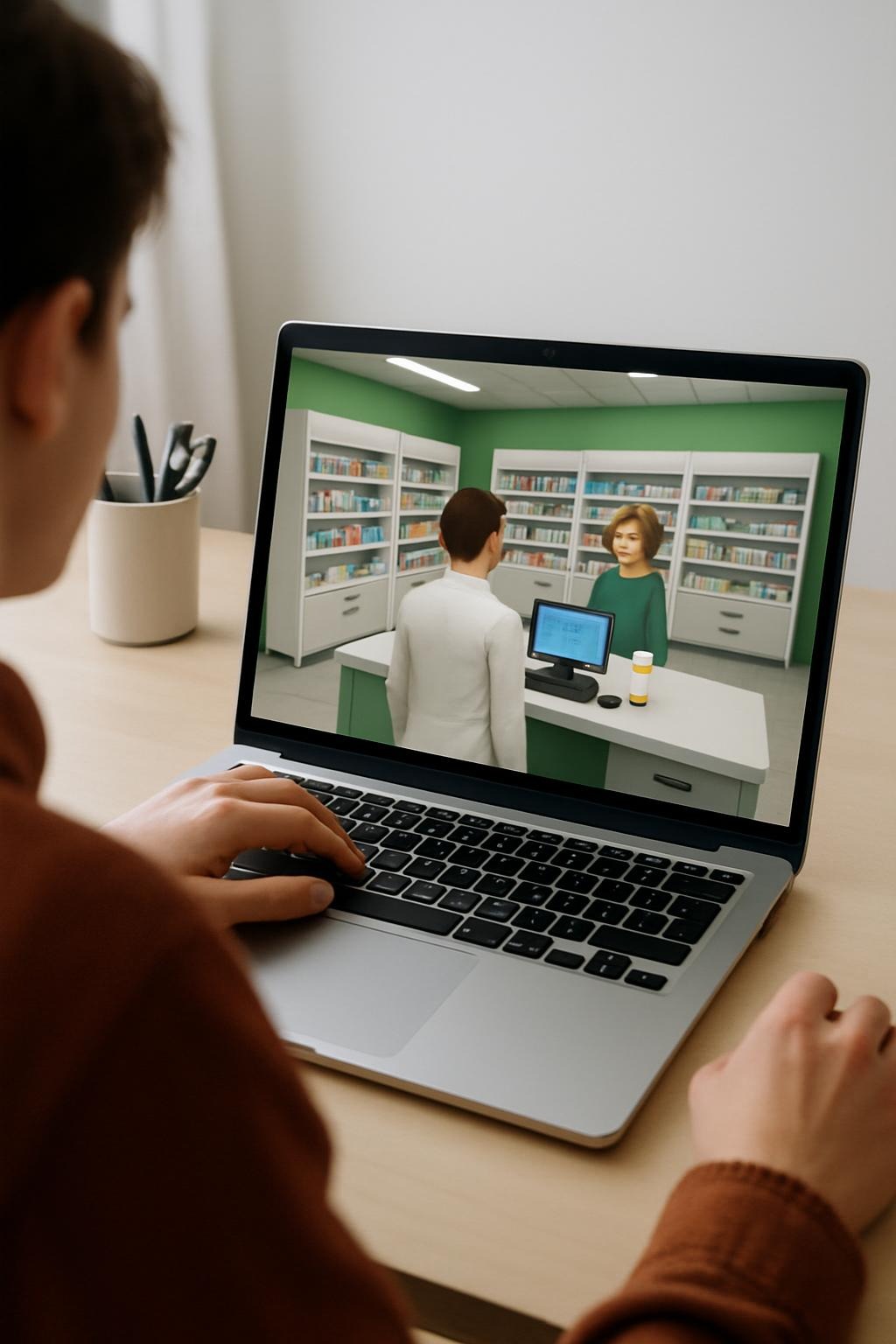
How do pharmacy simulators function?
There is a plan to create a virtual simulator for pharmacotherapy follow-up by adapting software so pharmacy students can practice and develop essential clinical skills for daily practice. For example, SIACC software was designed to develop, manage, and present virtual patient clinical cases online. The necessary steps to be carried out with the simulator have been identified and follow the pharmacotherapy patient follow-up scheme1:
Step 1: Establishment of a therapeutic relationship.
The pharmacist introduces himself as part of the multidisciplinary transplant team and explains their collaborative goals. The initial interview gathers patient demographics, including address, education, and caregiver presence. During this time, the pharmacist also builds a therapeutic relationship to earn the patient’s trust and support optimal clinical outcomes.
Step 2: Pharmacological Anamnesis.
The pharmacist gathers detailed information about the patient’s medication use and health, starting with open questions about health concerns. This encourages the patient to share all issues, not just medication-related ones. The patient recalls current medications, dosages, treatment length, and precautions. Next, questions cover routines like teas, herbs, alcohol, other drugs, diet, and daily activities. The pharmacist checks for drug-related problems or non-adherence. If issues are found, a tailored intervention is made, possibly involving the physician. The patient’s case is reviewed and shared at the next visit if needed. Finally, the next appointment is scheduled.
Step 3: Next meeting
The pharmacist asks the patient about their feelings and any medication changes. If changes occurred, the pharmacist reviews the care plan to update it or address new medication issues. They ask about family members with chronic illnesses, responses to the transplant, doubts about treatment, or homemade remedies. The patient’s living conditions, social networks, and views on illness and recovery are reviewed. These consider the patient’s daily life, beliefs, family, support, and healthcare access. Meetings with physicians occur as needed to discuss care plans, made by team consensus. Further meetings are scheduled based on patient needs and the care plan.
The Ten Golden Rules for Education Software
Jha and Duffy (2002) developed a training evaluation and, as a result, suggested ten golden rules for the best evaluation profile for systems supporting health education, with the intent of correcting the main faults in evaluation processes and creating a systematic evaluation of universal usage (Table 1).2
Table 1: The golden rules for education software
| Rule | Description |
| Rule 1 | Content should be suitable for the educational purpose, of good standard and relevant to clinical practice |
| Rule 2 | Content should be evidence-based, not opinion-based |
| Rule 3 | Use of hypermedia and hypertext to promote knowledge |
| Rule 4 | Ensure that the presentation is interesting, enjoyable and challenging |
| Rule 5 | Use of appropriate multimedia |
| Rule 6 | Use of a problem-based setting |
| Rule 7 | Content and tasks must stimulate analytic and problem-solving skills |
| Rule 8 | Product must be user-friendly, with easy navigation |
| Rule 9 | Must provide suitable impetus for use |
| Rule 10 | Must keep cost low and maintain strict production schedules |
Challenges and Limitations of pharmacy simulation-based training
Computer-based simulation (CBS) presents a scalable and effective approach to enhance learning and critical thinking. However, its integration into pharmacy education encounters several challenges that must be overcome for successful adoption. Key barriers include:
- Resistance to change
- Implementation and operational challenges
- Computer-based simulation alignment with the curriculum
Proposed solutions offer ways to overcome these challenges. Key strategies include clearly communicating the benefits of CBS to stakeholders, promoting interprofessional learning through simulation, utilizing champions to advocate for technology integration, and reducing educators’ workload by employing dedicated simulation technicians.3
Conclusion
The future of pharmacy simulation looks very promising as technology improves quickly. With the use of artificial intelligence, virtual reality, and augmented reality, pharmacy simulations will become more realistic and engaging. This will help students and professionals practice complex clinical situations safely. These tools will improve decision-making, boost patient safety, and support personalized learning. Also, using big data and predictive analytics in simulations will allow better modeling of drug interactions and patient results, leading to better training and healthcare. As pharmacy education changes, simulation will be key in preparing pharmacists for modern healthcare challenges.
References
- https://www.researchgate.net/publication/303518402_Use_of_a_Simulator_to_Develop_Clinical_Skills_for_Pharmacists
- Jha, V., & Duffy, S. (2002). ‘Ten golden rules’ for designing software in medical education: Results from a formative evaluation of DIALOG. Medical Teacher, 24(4), 417–421. doi:10.1080/01421590220145798 PMID:12193327
- https://pmc.ncbi.nlm.nih.gov/articles/PMC11390378/
If you’re interested in experiencing the benefits of pharmacy simulation firsthand, we invite you to explore our own advanced simulation software available on our website. Designed with the latest technology and tailored to meet the needs of both students and professionals, our software offers an interactive and immersive learning experience. Check it out today to learn more and take the first step towards enhancing your pharmacy skills with cutting-edge simulation tools.
Leave a Reply